TV property expert Phil Spencer supports the National Responsible Dog Owners Campaign

TV property expert and presenter of Channel 4′s Location, Location, Location Phil Spencer has today joined the growing list of supporters of the National Responsible Dog Owners Campaign.
The Campaign aims to reduce the number of dog bites and amount of dog fouling left in public spaces, promoting responsible dog ownership by educating dog owners and the general public in how to easily prevent dog bites, by better understanding dog behaviour.

Free resources, news, information, statistics and links are available on the National Responsible Dog Owners Campaign website: join the discussion on Facebook and sign the petition.

Share

Post to Twitter

+

The Doggie Bag: dog walking rucksack review

It’s quite often a challenge to remember everything you need when you leave to walk the dog. I’ve often got several steps down the road and had to head back for a bottle of water, a ball and sometimes even poo bags. It’s just impractical to keep one of everything in every coat or pair of trousers. Enter The Doggie Bag…

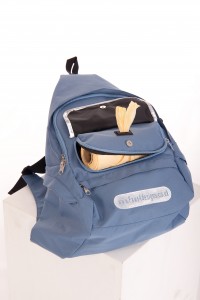
A featured product by the BBC at Crufts, The Doggie Bag is a comfortable rucksack in a modern design, and has four main zippered pockets, including one large main rucksack compartment to keep everything you could think of: phone, keys, ball, muzzle, training lead, extra treats, whistle, clicker, bottle of water, bowl, towel…. it can all fit in here! If anything gets dirty on your walk you can keep that in the removable, washable pouch at the bottom of the main compartment. But if that was it, then it’d just be a rucksack. The Doggie Bag is not just a rucksack, however…

The most ingenious thing about The Doggie Bag is that not only does it have a specially designed integral poo bag dispenser (yes, you read that right: lift up the magnetic popper flap and simply pull out a poo bag then replace the flap and no one would ever know you had in fact an entire roll of poo bags at your disposal designed into your rucksack!) but it even has an integral poo bin. A water resistant, removable, washable, drawstring pouch in the main compartment is the perfect place to carry full poo bags out of sight (and smell), leaving both hands free and you to enjoy your walk until you get to a bin. This feature alone is in my opinion, worth the price of the bag and a very clear statement both socially and for your conscience that you are a responsible owner. This is the first product that really does make a difference to every community, helping to promote responsible ownership.

If you do a lot of training on your walks (perhaps you’re training a puppy or have a reactive dog), maybe walk dogs for a living or perhaps have more than one dog and always have your hands full, I’d strongly recommend taking a look at The Doggie Bag. It’s available in a choice of colours and now with reflective piping to keep safe at dusk. I’ve only had mine a few days but the quality seems just fine in a wipe clean fabric that you’d expect in an outdoorsy bag like this. The zips appear to be sturdy and of good quality - one improvement I’d like to see are toggles attached to the zips to make it easier to open when your hands are wet and/or cold. It’s a fantastically well thought-out design though that has full support from the National Responsible Dog Owners Campaign.
£25 including 40 lightly scented poo bags
Available here.

Share

Post to Twitter

+

What to do with your new KONG chew toy - getting the most out of a KONG

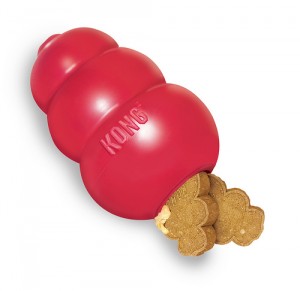
The performance and durability of the KONG chew toy is legendary; over the past 30 years they’ve set the standard for dog toys and are recommended by the leading veterinarians, trainers and behaviourists, including Jez Rose. Here’s a quick run down on how to get the most out of your KONG!

Very Important! No Dog Toy is Indestructible!
Supervise your dog’s use of KONGs until you are confident they can be used safely without supervision.

Clean and Inspect KONGs Frequently
Did you know you can put your KONG in the dishwasher? And even in the microwave? Great for melting some cheese on a chilly winter night. Look for cracks, separations and/or missing pieces and flex the KONG to inspect it from all angles. Loose pieces larger than a food nugget can be harmful if swallowed. Worn and damaged KONGs must be replaced immediately.

Your Dog’s Safety is Your Responsibility
If you think your dog has swallowed a toy fragment (for example: if the toy was damaged and you cannot find every piece larger than a food nugget), promptly inform your veterinarian.

Sizing
Proper KONG sizing is determined by your dog’s size and chewing temperament. It’s always best to ‘Size Up’: if your dog destroys a KONG in a short period of time, try a larger KONG and/or an Extreme KONG. Regular use of KONG will strengthen your dog’s jaw muscles so eventually you may need to ‘Size Up’ or switch to Extreme KONG.

More Information About KONG
Today, most domestic dogs don’t have to work for food. In nature, however, dogs are predatory meat-eaters. Hunting for food is physically and intellectually challenging so the hunt is their “work.” Success on the job results in a well-earned payoff: their meal. Eating meat off the bone satisfies their hunger, exercises their jaw muscles and keeps their teeth good for your dog. Depriving dogs of their natural drives can result in serious behavioural issues including excessive barking, destructive chewing, soiling, digging and separation anxiety.

Put Your Dog To Work!
Providing food and/or treat-stuffed KONGs for your dogs can keep them contentedly busy (“working”) and out of trouble for long periods of time. The hollow centre can be filled with food and treats: a dab of peanut butter spread around the inside is very effective. Why not put half of your dogs daily food allowance into the KONG instead of in their bowl? If you feed kibble, simply plug the small hole with some cheese or peanut butter, put the kibble into the large hole, add a little water and a quarter teaspoon of garlic powder, wrap in cling film and put into the freezer. When you remove it the following morning, your dog will have a frozen food toy to play with, keeping them busy, using physical and mental energy in a self-rewarding behaviour of getting the food from the KONG. Their unpredictable bounce lures most dogs into a game of chase, catch and chew which makes a great replacement for tennis balls.

Share

Post to Twitter

+

Dogs and babies - advice for dog owners with children in My Baby Radio interview

I was interviewed recently by My Baby Radio, the online radio station for families and new parents, to offer advice on living with dogs and children.

From My Baby Radio.com: “Introducing dogs and babies can be tough and introducing a family dog to a newborn baby is always a worrying time for parents. Attacks on little ones by man’s best friend seem to be reported in the media on a regular basis. However, canine behaviour specialist Dr. Jez Rose believes the incidents make the news because they are still relatively rare and it’s that which makes them worth reporting on.

If you’re the proud owner of a dog but have a new baby on the way, you may be worried about your pet’s reaction. Alternatively, your family could be thinking about getting a dog but you don’t know what to look for. Are some breeds better with children than others? Which ones need the most exercise? The list goes on!

Well, fear not because Jez Rose, a leading canine behaviour specialist has the answers to all your questions.

In this podcast, Jez outlines how you should involve your dog when your newborn arrives. He also argues that all dogs can be trained and there’s no such thing as a bad dog. One of the big mistakes is leaving children and dogs alone in a room together and he advises to listen to the dog’s warnings. If your dog is growling, move the child away.

Take a listen to the My Baby Radio podcast here and click here for a free poster which teaches children how to behave safely around other dogs and here for a poster which teaches the basics of doggy body language so you’ll know when they’re scared or uncomfortable.

Share

Post to Twitter

+

What is a dog whisperer and what does a dog whisperer do? How to be a dog whisperer explained

Dog whisperer is a pretty fancy title

Anyone can do Dog Grabbing, or Dog Shouting, or Dog Hitting but Dog Whispering sounds like it’s an innate, spiritually-found skill perhaps offered to a select few by the Sirius God of Dog Stars… maybe. Horse whispering shares the same etherial, almost angelic-sounding grace; it conjures up images of someone modestly dressed, knelt down beside the animal, communicating gently, using some sort of higher plane, or sixth sense to break through the obvious language barrier of two different species. You’d expect them to lay their hand on the horse - or dog - gently and calmly, only for the animal to accept them and strike an everlasting bond with them. Dramatic, peaceful and awe-inspiring. That’s what whispering with animals conjures up for me.

Pinning dogs down, growling at them, flipping them onto their backs, grabbing them, holding them up by their metal collar or shouting at them isn’t really conducive with my feeling of what “whispering” to a dog should look like. Call me old fashioned but I always expected something a little more - well, whispery. So if you have a problem with your dog and you watch or consult a “dog whisperer”, I for one wouldn’t expect them to so much as touch or raise their voice around the dog. And I’d certainly not expect them to bring out gizmos and gadgets that spray air or water at my dog or delivery electric shocks. Maybe Black Beauty had it lucky when she found that young kid who seemed to be able to get the horse to do what she wanted it to do, without any force or physical coercion. Does that exist in the real world? Can we really get animals to do what we’d like them to do, without touching them, causing them any pain or shouting at them?

Yes. Yes we can - and animal professionals do, every day, all over the world. What looks really easy to achieve takes a fair bit of understanding, a lot of practice and a lot of patience, too. Animal training is classically one of those things that falls into the “how hard can it be?” category. When people try something that doesn’t work or perhaps try something that works for a while and then doesn’t (what we animal professionals call extinction), they quickly become frustrated and resort to physical prompting or force. It’s trickier than you think to get a dog to do what you want it to do, however, the basics of “dog whispering” are straightforward enough for any and all dog owners to put into practice.

1. Respect that the dog may not feel like doing what you want it to do: it may be tired, in pain or simply uninterested.

2. Respect that dog’s don’t have to like you all the time - just like humans they like time on their own and may not want to be stroked, cuddled or moved.

3. True dog whispering is about understanding the animal - how do they feel? What are they thinking? How do we communicate with them and they with us? Take a look at this poster to get you started.

4. Understand punishment: what is a punishment anyway? Do we have to hit the dog or electrocute it or scare it? No, we don’t - and we shouldn’t. We can learn that punishment is simply a word given by professionals to mean the opposite of reward. Nothing about the word or its definition (“a stimulus that reduces the immediately precipitating behaviour”) says it has to be nasty or painful - not giving your dog a treat is for many an effective punishment - their very own “extinction”.

5. How can we reward our dogs correctly, in turn showing them that we understand them? What makes your dog tick? What do they really love doing that you can use as a reward to reinforce good behaviour, or behaviour you want to see more of? Is it treats, toys, a game of tug, being chased, a cuddle or the opportunity to sniff?

6. Work with your dog, train your dog or interact with your dog in short bursts of 15 minutes - 30 minutes at a time in order for the time to be effective and efficacious. Don’t over do it: you might have the stamina and the drive and know what the end goal is but the dog, as clever and willing as they appear are still only animals. Be patient.

So, there we go - you, too, can be a dog whisperer! A real dog whisperer, using the power of gentle communication. See how easy it is to start?

Share

Post to Twitter

+

Should I Get A Collar Or A Harness For My Dog? Dog collars versus dog harnesses, the pros and cons

Pulling on the lead is a very common complaint form dog owners who find it frustrating, not at all enjoyable and very often exhausting if not painful. However, seeing how intensely dogs can pull, often wheezing and coughing while doing so as their trachea is compressed, it must be pretty raw for the dog, too. Such is the power of conditioned responses in animals, such as dogs (“the only way to get this human to get to the park quickly is to literally drag her there!” or “wow! I smell squirrels - this feels uncomfortable on my neck but - squirrels!”).

There are many types of collar and many types of harness - some good but many bad. Few seem to have understood the anatomy of the dog in order to find the most comfortable and safest fit for the harness (taking into consideration the distribution of weight, load and anatomical position of various structures). It is now generally accepted, thankfully, that choke chains are not good but interestingly

Share

Post to Twitter

+

Wolf Cubs Born at the UK Wolf Conservation Trust Review

The fantastic UK Wolf Conservation Trust in Beenham has recently welcomed the birth of three beautiful wolf cubs: Tundra, Tala and Nuka, born to Mai and Motomo.

I’m currently writing a book about environment enrichment so I offered to provide the cubs with some stimulation and enrichment activities in their enclosure. At this age it’s great to encourage natural instincts including play and foraging for food and what better way than to stuff their food in a KONG chew toy?! Well known in the domestic animal setting, KONG is actually used widely in many zoos and captive animal environments, so the awesome people at KONG Company UK sent a box of KONG extreme over to the UK Wolf Conservation Trust.

Here are a few pictures of the cubs enjoying their rabbit meat stuffed into the KONG!

Share

Post to Twitter

+

The Children’s Guide to Woofs and Growls

This high-resolution poster can be printed and displayed in your practice or used for internal training. It teaches children how to safely behave around dogs, starring Boogie the Boston Terrier.

As with all of the Vet Resources, feel free to download and distribute freely to your clients. All rights are reserved, so please no selling!

You can download it here.

Share

Post to Twitter

1

The Dangerous Dogs Act Debacle - what is The Dangerous Dogs Act Review?

The Dangerous Dogs Act is a UK legislation introduced in 1991 (then reviewed in 1997 by a group of equally Prehistoric, histrionic officials) in response to a number of incidents of serious injury and death as a result of dog attacks. The dogs were identified as being uncontrolled and “aggressive” and the attacks were mainly on children. It is widely believed that the Act was a knee-jerk reaction in response to heavy media attention and public pressure, resulting in widespread public concern over the keeping of the so-called “dangerous” breeds that had been involved in the reported attacks.

This means that dogs classified under the Act as “dangerous” (which include Pit Bull Terrier, Japanese Tosa, Dogo Argentino and Fila Brasileiro), must be muzzled and kept on a leash in public, registered and insured, neutered, tattooed and microchipped. What a life. The Act also bans the breeding and sale of these dogs. All of this, despite the fact that globally, more dog bites involve Labradors than any other breed and Pit Bull Terriers are an extremely common breed in the USA. Perhaps the “dangerous” Pit Bull Terrier gene couldn’t swim as far as the USA and they were lucky?…

Confusion often arises because the Act covers cross-breeds of the above dogs, being classified as a “type” of dog rather than an actual breed: IE “it was a Fila Brasileiro type dog”. Pit Bulls have a particularly bad name, which is a shame as they, like any dog, can make excellent pets if socialised and trained as a puppy. Equally they, like any dog, can make particularly dangerous companions because of a lack of socialisation, training… and the presence of teeth. The Act defines that there are only 5 types of dangerous dog which should be banned, despite the presence of perfectly normal Pit Bulls in other countries, which I imagine is a little grating for those that have been attacked by other breeds such a Collies.

The problem surrounding the Act is that many dogs are bred, raised and trained to fight and act as status symbols by being aggressive. As a professional dog trainer, I am capable of teaching any dog to behave in an aggressive manner - not that I do: just like humans, dogs will only be pushed so far. As my mentor says: “humans, dogs and horses are the three most commonly abused species in the history of mankind”.

This is key, because what we actually need is not a review of breeds or types but ore action on the prevention of attacks, understanding that it is by training dogs and socialising them early that we can produce dogs that like and get on with dogs and people. The answer is in education.

Share

Post to Twitter

+

Predator to Pet wolf workshop at the UK Wolf Conservation Trust Berkshire October 2011

Join the UK Wolf Conservation Trust in Beenham, Berkshire for an exciting and fast-moving workshop, developed in association with Wolf Park of Indiana.

This hands-on workshop will chart the domestication of dogs, from their wild roots to the present day. Topics include:

: Taxonomy of the canids
: Genetic evidence of the relationship between dogs and wolves
: Domestication versus socialisation
…and more!

A walk with an ambassador wolf is included, allowing you to see firsthand the wild ancestor of today’s dogs. You’ll also receive a gift as a memento of the day! It’s a fantastic day out and one I highly recommend; they do a great job in both education and conservation.

Tickets are available to book online here.

The next Predator to Pet Workshop is Saturday 15th October.

Share

Post to Twitter

+